We rail against suburbia, but it is not the enemy: it is only our version of the enemy. And enemy is not even the right word for it, this unseen power we feel over and around us, pushing us from behind into the crowd, or a dark pit, the fall and the feel of the bottom we know and dread.
Selfishness has gone global. Europeans import our political and financial clouting, covering their moves with their historical sly grin and sideways step. We import their philandering, covering it up with a sheen of Biblical adjectives and calls to war.
The West consumes and pollutes more only because we can. The Third World aspires to our gluttony, dreams of our geo-politico-historical good fortune. We look on with a tear not quite falling from our eye and say, “God has blessed us, let us beacon freedom and democracy.”
Every day we die a little more, but never enough to change. Our daily destruction takes place in the malls, on the freeways, in the megaplexes and megachurches where we are reminded that we are not rich enough, not fast enough, not beautiful enough, and not morally perfected enough to call ourselves a Generation, to fight our Great War, to hold our High Office, to have our sway, our turn at bat.
So we attack the cul de sac, the SUV, the Sunday-school teacher, the overweight woman ordering a number five, super-sized.
But it is not this accumulation of small deaths. It is how the small deaths prevent any real death at all. They are in fact small taxes paid to the god of ourselves, so that we may never have to face a God of us all. They are sidesteps, diversions, truths we tell ourselves, careers, gourmet dinners, anonymous sexual encounters.
And the more we rail, and the more we divert, and the more we wield our wild power over others, the more we begin to enter this game first cheering, then standing, then fighting with the other side–the side of the dead but never dying, the undead.
YAJMF
A few days ago I tried to explain to my parents how I was able to forgive so easily. I tried to explain that I understand that we all build these stories to disable the dissonance our decisions cause. Truth and lies aren’t so much about right and wrong as about the state of our fragile psychologies. The forgiveness of Christ, as I have come to understand it, gives us the freedom to accept that fragility, the horrors that are our actions, the dead bodies on the floor, the knives in our hands.
The gospels aren’t so much about miracles as they are about dismantling the prefab story-houses people had built around themselves, from the tax collector to the adulterous woman to Judas.
Sanctification isn’t about becoming perfect, it’s about coming to terms with the fact that we are the scum of the earth. “The last will be first.” “The least of these.” Yet Another Jesus Mind-Fuck.
I say, stop being perfect.
– Fight Club (Chuck Palahniuk)
So many people coming out of Christian culture are really postmoderns but have a hard time with some things because the Christianity they learned was built on modern binaries…but modernism isn’t old. It wasn’t modernism since the time of Christ and then postmodernism. These issues of ambiguity (moral or otherwise) are not new. Modern/evangelical Christianity didn’t solve the problem of life, despite their advertisements to the contrary.
These are the persistent problems of humanity and the permanent problems in a human life. Christ didn’t come to answer the questions or solve the problems, he came to be a co-journeyman with us, and to reconcile us with the fact that we’re never going to get it, never going to solve this problem, never going to be holy.
They never tell you the truth is subjective
They only tell you not to lie
They never tell you there’s strength in vulnerability
They only tell you not to cry– Gary Jules, Something Else from Trading Snakeoil for Wolftickets.
The church doesn’t prepare you for suffering, for the whole of life in which both happiness and sadness, victory and tragedy are certain to occur. The only real sin is in the lies that cover up the sin, that sin when spoken about loses all its power to destroy us.
Rolling around in the dirt is essential to the spiritual life.
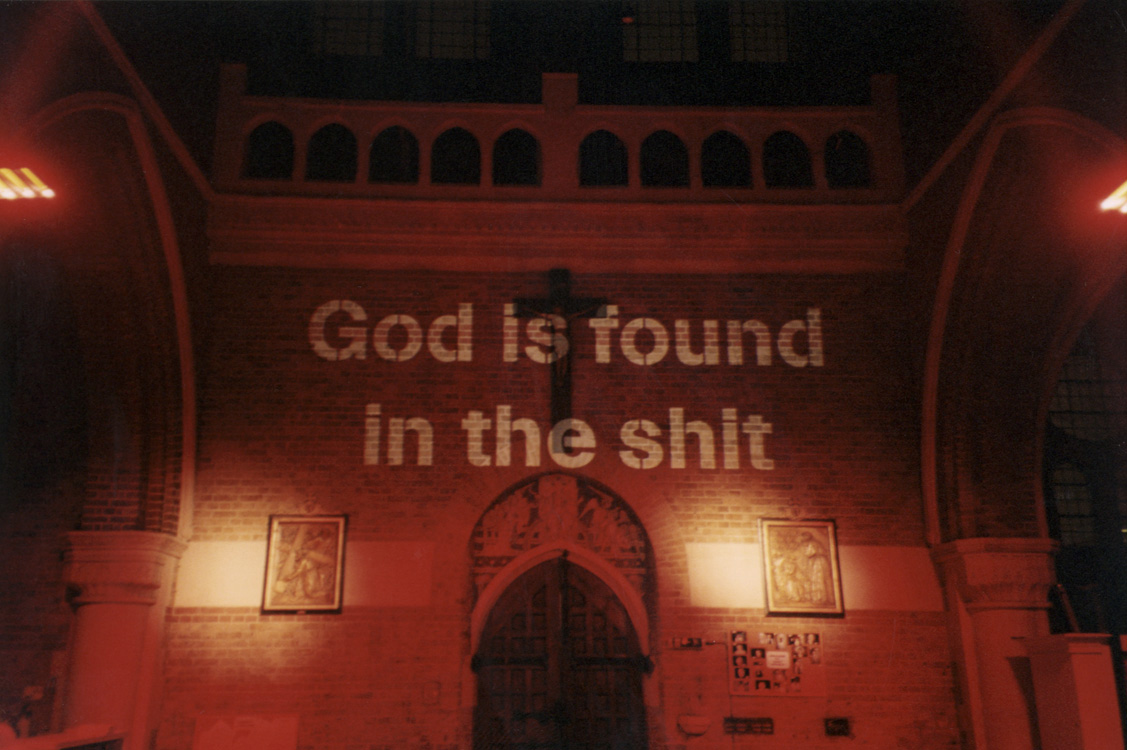
Vaux / God is found in the shit / 01-2002
What is curious is that in church, where things should be the most open and expectation-less, they are the most closed and expectation-ridden, and in bars all across the country people are welcomed with open arms regardless. People in churches expect their music to be a certain way, their theology to be a certain way, and especially their leaders to be a certain way.
Maybe being totally perfect isn’t all it’s cracked up to be. Maybe there is a fear that comes late at night, on a rare night alone, in the dark of a cold winter after the city has quieted its daily celebration. Maybe there is a fear that it might not last. Maybe there is a knowledge of terror, of that sun of success and comfort and ease making its way towards the horizon. Maybe there is an uncertainty of how long the ensuing night will last. A lack of experience of how long that closest star will be pointed at the other side of the world.
Or maybe it’s because that sun has already made a trip around. Darkness had already visited a life, and that life decided during the night that the stars were not to be trusted. It was the longest night of her existence, and she swore in the middle of cold, early morning hours that if the sun ever came up again, she would revel in it, full of spite for whoever or whatever sent it back across the sky. They were not to be trusted. They were not to be thanked.
And then I think, this night is beautiful. The stars form patterns against the haze of the city. A candle casts subtle tones over the pages of a book. The silence allows other voices to be heard.
The pain allows for the pleasure. The loneliness teaches what affection is. The darkness reminds us that without the light we bump our knees on countless coffee table corners.
We can’t pretend that the day will last forever. We can’t force the dawn with our anger and betrayal.
We can live. We can learn. We can accept our fates of suffering, and if we are lucky, that suffering will teach us how not to force the sun to set on other lives sharing this universe with us.
Whenever we’re led out of normalcy into sacred space, it’s going to feel like suffering. It’s letting go of what we’re used to. That causes suffering. But part of us always has to die. If that readiness isn’t there, we won’t enter into sacred space. The prophet leads us into sacred space by showing us the insufficiency of the old order; the role of the priest is to teach us how to live in the new realm. Unfortunately, the priest too often operates separately from the prophet. He talks of a new realm but never leads us out of the old order where we are still largely trapped. (Such priesthood is ineffective, though quite popular.) In this new realm, everything belongs. This awareness is often called a second naiveté. It is a return to simple consciousness. The first awareness is a dangerous naiveté. As I’ve said, it doesn’t know but thinks it does. In the second naiveté the darkness and light coexist, paradox is revealed, and we are finally at home in the only world that ever existed. This is true knowing. Here death is a part of life, and failure is a part of victory. Opposites collide and unite, and everything belongs.
– Richard Rohr, Everything Belongs
I think that where the post-War church has failed is where the conversion experience has turned into a self-help program, when really much of what Jesus said was a self-destruction program…“If you can’t leave your mother and father and follow me…” “Sell all your possessions…” etc., etc. It’s material destruction, even the material of our emotions; but the point is spiritual gain.
The CLOP
My experience with the divorce is like the poster story for the false validity of my earlier best attempts at the idealistic Evangelical Christian Life of Perfection (CLOP): This is what you DO: You Get Married. Marriage, in fact, and along with it sex and divorce, are the touchstone issues in the CLOP. There are perfectly good reasons for this: sex and committed, lifelong partnership are two of the most psychologically profound issues of the human soul. I don’t wish to diminish that. But for a young, single, lonely, horny Christian person, marriage is it. The more important issues surrounding the decision for marriage and the personal requirements of such are rarely given their deserving light. Sure you’ll sit through the church-sponsored pre-marriage counseling…but it’s still all in the context of, “Here’s how a marriage is supposed to be. Here’s the CLOP marriage,” if you will. There’s little talk of the realities of conflict, desires, what unconditional love is and what we can expect in the way of giving or receiving it. If there are horror stories, they always end in victory.
In the CLOP, there’s no room for suffering, for the ambiguity of expectations, for the haziness in which the path is set before you…and so when we ultimately come across those things, when we die as Rohr puts it, we’re not ready. Some people will pass into the new realm, where they find a stronger faith despite or in spite of the new exposure to the elements of the world, but others just won’t. They won’t be able to enter into that place where the darkness and light coexist and paradox is revealed, they won’t be at home in the only world that ever existed. They need the CLOP world. They need the comforts of America, or of having all their emotional needs met by their spouse, or being physically healthy, or having children, or succeeding in their profession…
The fact is, this country is so normal that we eliminate the possibility of God in our lives. So much of what we do as a society is to maintain that normalcy.